
What Is kWp? Complete Guide to Solar Panel Power and Output
Learn what kWp means in solar panels, how it differs from kWh, and how to size your system for optimal energy output and savings.

If you're researching solar panels, you’ve likely seen the term kWp everywhere - on quotes, brochures, and installer websites. But what does it actually mean?
Understanding kWp is essential because it determines:
- The size of your solar installation
- Your system’s power and output
- The cost and savings potential
- Your eligibility for certain incentives or tariffs
In this guide, we break it down clearly so you can plan your solar project with confidence.
What is kWp in solar panels and how is it different from kWh?
kWp (kilowatt peak) is the unit used to measure the maximum power output of solar panels under ideal conditions.
- “kW” = kilowatt (power)
- “p” = peak (maximum performance)
In simple terms:
kWp tells you how powerful your solar panel system is at its best possible performance.
Example:
- A panel rated at 500 Wp can produce up to 500 watts
- 1,000 Wp = 1 kWp
- A typical home system might be 3 kWp to 6 kWp
Wp vs kWp: what’s the difference between watt-peak and kilowatt-peak?
Since 1,000 Wp = 1 kWp, Wp is typically used to refer to a single panel, while kWp is used for a complete installation.
A concrete example:
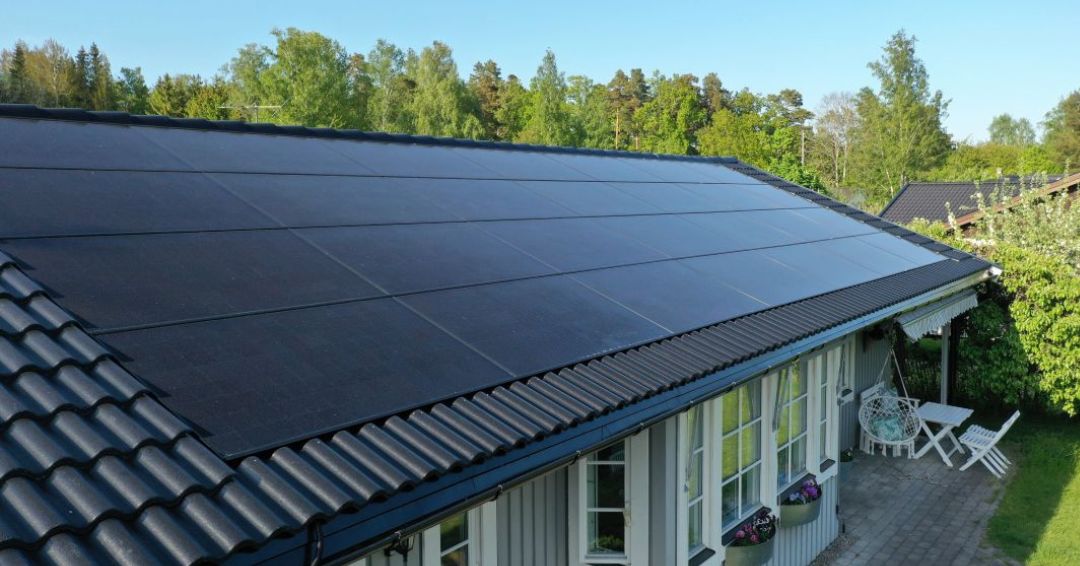
- A SunPower Shingled Black panel can produce up to 515 Wp (i.e. 0.515 kWp)
- A system of 6 panels represents just over 3 kWp
- A system of 12 panels reaches just over 6 kWp
kWp vs kWh: how to stop confusing power and energy
This is the most common confusion. Here’s the difference in one sentence:
- kWp measures power: what your panels can produce at a given moment
- kWh measures energy: what your panels actually produce over time
Think of a car:
Engine power (horsepower) = kWp
Distance traveled (kilometers) = kWh
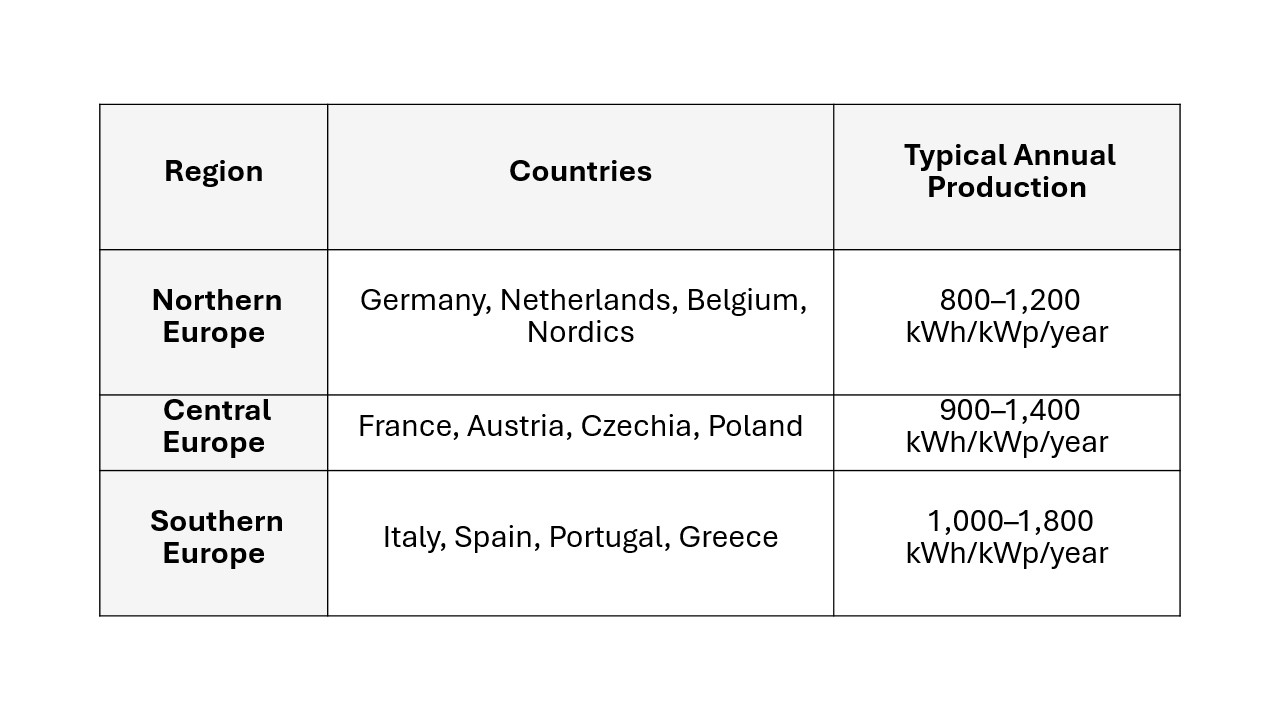
In France, a 1 kWp installation produces on average between 900 and 1,400 kWh per year, depending on your region’s sunlight. In Germany, that would be between 800 and 1200 kWp, while in Spain, from 1000 to 1800 kWh per year.
Output depends on:
- Your location
- Roof orientation and tilt
- Panel efficiency
- Shading
- Temperature
Under what conditions is kWp measured?
What are STC conditions and why are they never reached at home?
kWp is measured in laboratory conditions known as STC (Standard Test Conditions):
- Solar irradiance of 1,000 W/m² (intense overhead sun)
- Cell temperature of 25 °C
- Standard air mass (AM 1.5)
These conditions allow objective comparison of all panels on the market.
But in real life? The sun is rarely perfectly overhead. Temperatures exceed 25 °C in summer. Clouds appear. So your system produces slightly less than its kWp rating - which is completely normal and expected.
That’s why it’s essential to simulate your real production in kWh.
Why does one kWp from a SunPower panel produce more kWh than a standard panel?
Not all kWp are equal. The difference lies in panel efficiency: its ability to convert sunlight into usable electricity.
SunPower panels achieve some of the highest efficiencies on the market:
- Back-contact SunPower panels: up to 24.7% efficiency
- Shingled SunPower panels: up to 23.8% efficiency
For comparison, a standard panel is around 23% efficient. This means that for the same roof area, SunPower panels generate significantly more electricity - a real advantage if your roof is small or partially shaded.
How many kWp do you need for your home?
This is the key question.
How to calculate the kWp you need based on your annual consumption?
Rule of thumb : to cover about 50–70% of your consumption, allow roughly 1 kWp for every 1,000 kWh of annual use.
Typical UK household examples:
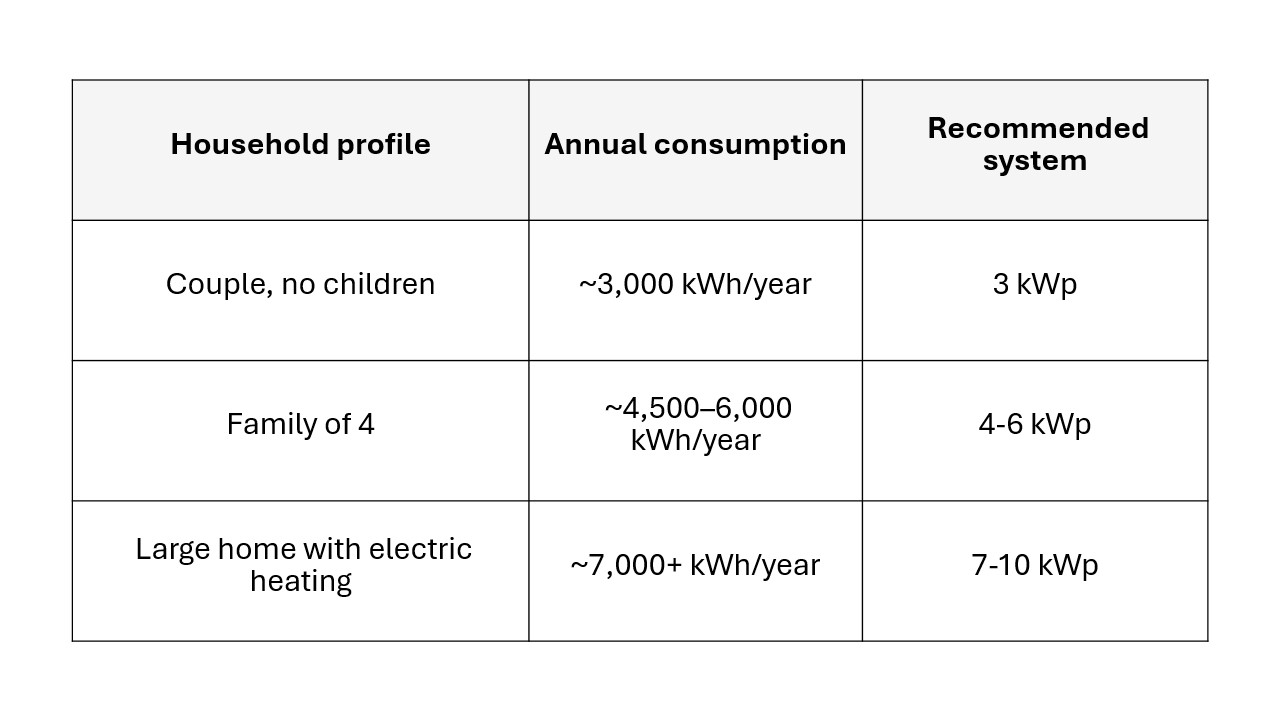
These are estimates. For a personalized and free assessment, contact certified installers.
How much roof space is needed per kWp?
A practical rule:
Allow about 4 m² of roof per installed kWp with high-efficiency panels.
Examples:
- 3 kWp → ~12 to 14 m²
- 6 kWp → ~24 to 30 m²
- 9 kWp → ~36 to 40 m²
The higher a panel efficiency is, the less space you need on your roof to achieve your energy goals.
How does a kWp impact cost and savings?
Savings: power measured in kWp is one of the factors impacting your return on investment
Cost increase with the size of your installation, so with any additional kWp.
In the past, some support schemes depended on the size of your installations, and export tariffs were high so you may have had an interest in selling your energy surplus. Today in the UK, support schemes have evolved into the Smart Export Guarantee (SEG), which pays households for excess solar electricity exported to the grid - typically between £0.02 and £0.15 per kWh depending on the supplier and tariff, but overall rates remain relatively low. Self-consumption has become the way to go.
Correctly sizing your system in kWp is critical for maximising savings. The more of your electricity you use yourself, the higher your savings.
Should you add a battery?
Battery storage allows you to store solar energy during the day and use it in the evening, when energy prices usually are at their peak.
Our pro tip? Adding a battery increases your benefit, because you store excess power instead of exporting it cheaply and you can use it later when electricity is more expensive.
Take action
You now understand what kWp really means:
- How much you need
- What roof area is required
- What savings to expect
Next step: get your free personalised quote.
In just a few clicks, SunPower partner installers analyse your roof and consumption and design a system sized to the nearest kWh.
FAQ - kWp in simple terms
Is kWp the same as kW?
No. kW measures the power of standard devices. kWp is specific to solar panels and represents peak power under test conditions.
How many kWh does 1 kWp produce per year?
Depending on region, orientation, tilt and panel performance, these are typical annual solar production data :
Does a SunPower kWp really produce more than a standard one?
Yes. With up to 24.7% efficiency, it converts more sunlight into electricity-producing more with less surface area.
Can I increase my system’s kWp later?
Yes, in most cases - if your roof space and inverter allow it.
What’s the difference between kWp, kWh, and kVA?
- kWp: peak capacity of your panels
- kWh: actual energy produced or consumed (your bill)
- kVA: apparent power (used for inverters and meters)